How to Evaluate Yourself as a Leader: A Practical Guide to Self-Assessment

Leadership is a never-ending journey of growth. It requires self-awareness, adaptability, and a commitment to continuous improvement. That’s why evaluating yourself as a leader is so crucial to your long-term success. Self-evaluation is a powerful way to identify your strengths, uncover areas for development, and ensure you’re effectively guiding your team toward success. In this post, we’ll look at practical steps to assess your leadership skills, reflect on your impact, and set a course for growth.

Why Self-Evaluation Matters for Leaders

Self-evaluation is more than just a personal check-in; it’s a proactive step to align your actions with your values and goals. By regularly assessing your leadership, you can:

Gain Clarity: Understand how your behaviors and decisions impact your team.

Build Trust: Demonstrate accountability by recognizing and addressing your weaknesses.

Drive Growth: Identify opportunities to enhance your skills and leadership style.

Inspire Others: Model self-reflection, encouraging your team to grow alongside you.

Let’s dive into a step-by-step guide to evaluating yourself as a leader.

Step 1: Define Your Leadership Values and Goals

Before you can evaluate your performance, you need a clear benchmark. Start by reflecting on your core leadership values and goals:

What kind of leader do you want to be? Are you aiming to be collaborative, decisive, empathetic, or innovative? Perhaps all of the above? Write down 3-5 core values that define your leadership philosophy.

What are your goals? Consider both short-term objectives (e.g., improving team communication) and long-term aspirations (e.g., fostering a culture of innovation).

How do these align with your organization’s mission? Ensure your personal leadership goals support the broader vision of your team or company.

Action Tip: Create a “Leadership Mission Statement” that encapsulates your values and goals. For example: “I strive to lead with empathy and clarity, empowering my team to achieve excellence while fostering a culture of trust and collaboration.” Post your mission statement where others can see it. That will help create accountability and build a bridge to step 2.

Self-evaluation is incomplete without external perspectives. Others can provide insights into how your leadership is perceived and its impact on the team. Here’s how to gather meaningful feedback:

Ask for 360-degree feedback: Collect input from peers, direct reports, and supervisors. Use anonymous surveys or one-on-one conversations to encourage honesty.

Ask specific questions: Instead of vague prompts like “How am I doing?”, ask targeted questions such as:

• “What’s one thing I do well as a leader?”

• “What’s one area where I could improve my support for the team?”

Listen without defensiveness: Approach feedback with an open mind, focusing on growth rather than justification.

Action Tip: Use a tool like Google Forms or a platform like SurveyMonkey to create a simple, anonymous feedback survey. Schedule follow-up discussions with your team to clarify feedback and show your commitment to acting on it.

I’m really close to saying that EQ is even more important for a leader than IQ. That’s because emotional intelligence is a cornerstone of effective leadership. It involves self-awareness, self-regulation, empathy, and relationship management. To evaluate your EQ:

Self-Awareness: Reflect on how well you understand your emotions and their impact on your decisions. Do you recognize when stress or frustration affects your leadership?

Self-Regulation: Consider how you handle challenges. Do you stay calm under pressure, or do you react impulsively?

Empathy: Ask yourself how well you understand and respond to your team’s needs. Do you actively listen and show genuine care for their perspectives?

Relationship Management: Evaluate your ability to build trust, resolve conflicts, and inspire collaboration.

Action Tip: Take an online EQ assessment, such as the Emotional Intelligence Appraisal by TalentSmart, or journal about a recent leadership challenge to analyze how your emotions influenced your actions.

Leadership is often judged by outcomes. Evaluate your decision-making process and the results of your leadership:

Decision-Making Process: Are your decisions informed, inclusive, and aligned with your values? Do you seek different perspectives before acting?

Impact on Team Performance: Look at measurable outcomes, such as team productivity, morale, or project success. Have your actions led to positive results?

Adaptability: Reflect on how you handle change or uncertainty. Do you pivot effectively when faced with challenges?

Action Tip: Review a recent project or initiative you led. Write down what went well, what didn’t, and one decision you would approach differently next time. Use this to identify patterns in your leadership style.

Effective communication is critical for leadership success. Assess how well you convey ideas, listen, and encourage open dialogue.

Clarity: Do you articulate goals and expectations clearly? Are your instructions easy to understand?

Active Listening: Do you genuinely listen to your team’s ideas and concerns, or do you dominate conversations?

Feedback Delivery: Are you constructive and specific when providing feedback? Do you balance praise with areas for improvement?

Action Tip: Record a team meeting (with permission) or ask a trusted colleague to observe your communication style. Note areas where you excel or could improve, such as body language or tone.

A leader’s success is tied to their team’s growth and motivation. Evaluate how you are fostering a positive and productive environment:

Team Development: Are you providing opportunities for your team to learn and grow? Do you delegate effectively to build their skills?

Engagement: Are team members motivated and committed? Do they feel valued and empowered?

Culture: What kind of culture are you creating? Is it inclusive, collaborative, and aligned with your values?

Action Tip: Conduct a “stay interview” with team members to understand what keeps them engaged and what could improve their experience. Use their insights to assess your impact as a leader.

Self-evaluation is only effective if it leads to action. Based on your reflections and feedback, identify 1-3 areas for improvement and create a plan:

Be Specific: Instead of “I’ll be a better communicator,” aim for “I’ll practice active listening by summarizing team members’ points in meetings.”

Set Measurable Goals: For example, “I will implement monthly one-on-one check-ins with my team to improve engagement.”

Seek Resources: Consider leadership training, books (e.g., The Five Dysfunctions of a Team by Patrick Lencioni), or a mentor to support your growth.

Action Tip: Create a 30-60-90-day plan outlining specific actions you will take to improve. Review your progress regularly to stay accountable.

Leadership evaluation isn’t a one-time task—it’s an ongoing practice. Build self-reflection into your routine:

Daily Reflection: Spend 5 minutes at the end of each day journaling about a leadership moment—what went well and what could be better.

Monthly Check-Ins: Revisit your leadership mission statement and goals to ensure you’re on track.

Annual Deep Dive: Conduct a comprehensive self-assessment, including 360-degree feedback, to measure your growth over time.

Action Tip: Use a journal or app like Evernote to track your reflections and progress. Set calendar reminders for monthly and annual check-ins.

Final Thoughts

Evaluating yourself as a leader requires honesty, humility, and a commitment to growth. By defining your values, seeking feedback, assessing your emotional intelligence, and reflecting on your impact, you can gain a clear picture of your strengths and areas for improvement.

The goal isn’t perfection but progress—each step you take toward becoming a better leader inspires your team and drives meaningful results. As you become a more effective leader, your team becomes more effective as well. And never forget, not even for a moment, that your leadership is not about you; it’s ALL about the people you lead.

So, take the first step today: carve out 15 minutes to reflect on one aspect of your leadership, such as how you handled a recent challenge. Then, commit to one small action to improve. Your team—and your future self—will thank you for it.

One-Time
Monthly
Yearly

Consider supporting my efforts with a gift!

Hey everyone, I’m passionate about sharing insights on life and leadership through my blog. If you’ve found value in my posts and wish to see more content like this, please consider making a donation. Every little bit helps in continuing to provide quality guidance and inspiration.

But whether you can offer support or not, I’ll continue to try and write a blog that gives back, informs and sometimes even entertains. I hope you enjoy it!

Thanks for your support!

Make a monthly donation

Make a yearly donation

Choose an amount

$5.00
$15.00
$100.00
$5.00
$15.00
$100.00
$5.00
$15.00
$100.00

Or enter a custom amount

$

Your support is greatly appreciated.

Your contribution is appreciated.

Your contribution is appreciated.

DonateDonate monthlyDonate yearly

Demonstrating You’re a Leader Who Cares

There are certain “facts” of leadership that are immutable. The biggest one is this: you can care for people without leading them, but you absolutely can’t lead people without caring for them.

I chose the words in that prior sentence very carefully. Before you go patting yourself on the back because you’re a leader who cares about their people, you should notice I didn’t say “care about.” I said care for people.

There is a world of difference between “care about” and “care for.” Both in terms of mindset and actions. Anyone in a managerial role will care about their people. Much like they care about their budget, their inventories, their building, and all the “stuff” that goes into running a business.

Authentic Leaders care about all that stuff too, what separates them from leaders in name only is that they go beyond caring about the people they lead. They care for the people they lead. That means they invest a part of themselves into their people’s success. They aren’t just concerned with the performance of their people “on the job.” They are invested in the lives of their people outside of the organization as well.

Authentic Leaders know that the people who work with them are human beings. They know that it’s actually impossible to completely separate “work life” from life in general. So they don’t expect or ask the people they lead to do that. They know that the human beings they lead need to be cared for. They need to know they are cared for. They can’t just be told they are cared for, they need to see it. They need to feel it.

So Authentic Leaders are intentional, proactive, and consistent in showing the people they lead that they are indeed cared for.

Demonstrating that you’re a leader who cares for the people you lead involves a combination of behaviors, communication styles, and actions that show empathy, respect, and genuine concern for their well-being. Here are some key strategies to effectively show your people that without a doubt, you really do care for them.

1. Active Listening

• Give full attention: When your team members speak, listen actively without interrupting. Show that you value their input.

• Reflect and clarify: Paraphrase what they’ve said to ensure understanding and demonstrate that you’re engaged.

• Ask for feedback: Regularly seek their opinions on decisions that affect them.

2. Empathy and Understanding

• Recognize individual challenges: Understand that each team member has unique personal and professional challenges.

• Show compassion: Respond to their issues with empathy, offering support where possible.

3. Transparent Communication

• Be open and honest: Share information about the organization, decisions, and changes openly.

• Encourage questions: Create an environment where team members feel comfortable asking questions and voicing concerns.

4. Support and Development

• Invest in their growth: Provide opportunities for professional development and career advancement. Encourage them, often, to take advantage of those opportunities.

• Offer constructive feedback: Help them improve by giving feedback that is specific, actionable, and supportive. You have to “do better” is not constructive feedback. Again, specificity is the key to constructive feedback.

5. Recognition and Appreciation

• Celebrate achievements: Acknowledge both small and significant accomplishments publicly and privately.

• Personalize recognition: Tailor recognition to the individual’s preferences and needs. Yes, this requires more effort, but Authentic Leaders put forth this level of effort all the time.

6. Creating a Positive Work Environment

• Promote work-life balance: Encourage taking breaks, vacation time, and maintaining a healthy work-life balance. And let’s be real clear on this one, if you’re pushing your people to extremes, to working 24/7 with no life outside of work, then you may be a boss, but you’re no leader.

• Foster teamwork and collaboration: Create opportunities for team-building and collaborative projects.

7. Leading by Example

• Exhibit the behavior you expect: Model the values and behaviors you want to see in your team. Whether you realize it or not, you ARE leading by example. Your people are always watching. They will do what they see you do 1000 times faster than they will do what you say to do. So if you’re having performative issues with your people, the first place to look is in the mirror.

• Show resilience and optimism: In times of challenge, demonstrate resilience and a positive attitude. Authentic Leaders create hope where despair once existed. If you can do that, you’re an Authentic Leader.

8. Availability and Support

• Be accessible: Make yourself available to your team for support and guidance.

• Provide resources: Ensure they have the necessary resources and tools to perform their tasks effectively.

9. Personal Interest

• Know your team members: Take the time to learn about their interests, families, and personal lives.

• Check-in regularly: Have regular one-on-one meetings to discuss their progress, concerns, and well-being.

10. Empowerment and Trust

• Delegate responsibility: Trust your team members with important tasks and decisions.

• Encourage autonomy: Give them the freedom to approach their work in their own way, fostering a sense of ownership and responsibility.

When you consistently use these ideas you’ll demonstrate that you are a leader who genuinely cares for the people you lead. The key is “genuinely.” You might be able to fool some of the people for a little while, but if your caring is not sincere they will figure it out in relatively short order. And once they figure out you don’t really care for them, they will no longer care to follow you. Then my friend, your days as a leader are numbered.

One-Time
Monthly
Yearly

Consider buying my next Diet Coke(s)
Yes, I know it’s not the healthiest beverage but I kind of sort of live on the stuff… and the stuff is getting as expensive as gold. 😋
I’d appreciate any support but seriously, support or not, I’ll continue to try and write a blog that gives back, informs and sometimes even entertains. I hope you enjoy it!

Make a monthly donation

Make a yearly donation

Choose an amount

$5.00
$15.00
$100.00
$5.00
$15.00
$100.00
$5.00
$15.00
$100.00

Or enter a custom amount

$

Your contribution is appreciated.

Your contribution is appreciated.

Your contribution is appreciated.

DonateDonate monthlyDonate yearly

How to Demonstrate that You’re a Leader Who Cares

One of the easiest things for someone in a leadership position to do is tell their people that they care about them. The reality is, many followers doubt the sincerity of those words. That’s why Authentic Leaders remove all doubt by demonstrating, on a consistent basis, that they do actually care about their people. Demonstrating that you’re a caring leader is essential for creating a positive and productive organizational culture. It builds trust among your team members and promotes their well-being.

There are about a gazillion ways to show you care, here are several that can have an immediate impact with your team.

• Pay close attention to your team members when they speak. Show empathy by nodding, making eye contact, and asking clarifying questions. This demonstrates that you value their thoughts and concerns.

• Encourage open and honest communication within your team. Create safe spaces where people feel comfortable sharing their ideas, problems, and feedback without fear of judgment or reprisal. By the way, it’s best if the entire organization is one giant safe space. People looking over their shoulder to see if it’s “safe” to say something are less productive than those who know their safety is assured.

• Put yourself in your team members’ shoes. Try to understand their perspectives, feelings, and needs. When they face challenges or personal issues, express empathy and offer support.

• Be accessible to your team. Make sure they know they can come to you with their concerns, whether they are work-related or personal. Maintain an open-door policy, or set aside regular times for one-on-one meetings.

• Acknowledge and appreciate your team members’ contributions and accomplishments. Recognition can be verbal praise, written notes, or other forms of acknowledgment, and it shows that you value their efforts.

• Invest in your team’s professional growth. Help them set and achieve their career goals. Provide opportunities for learning and skill development, and offer guidance and mentorship.

• Promote a healthy work-life balance. Encourage employees to take breaks, use their vacation time, and avoid overloading them with excessive work. Show understanding when they need to attend to personal matters.

• Be flexible when possible. Accommodate reasonable requests for flexible work hours to accommodate people’s needs. Things like family responsibilities or personal health issues matter and you should never ignore them.

• Address conflicts and disagreements within the team promptly and impartially. Encourage a resolution process that respects everyone’s perspectives and feelings. You’ll likely have to fight the normal human behavior of playing favorites but if you want complete engagement of your team you will fight that fight.

• Demonstrate the behaviors and values you expect from your team. Show that you prioritize caring and empathy in your interactions with others.

• Recognize that each team member is unique. Tailor your leadership style and support to their individual needs and preferences. Remember, the “one size fits all” leadership style generally fits no one.

• Continuously seek feedback from your team on your leadership style and areas for improvement. Show that you are open to making changes based on their input. Listen to them and implore as many of their ideas as possible and when you can’t implement an idea tell them exactly why.

There is no doubt that consistently demonstrating that you care for your people requires effort, sometimes even great effort. But the rewards make those efforts well worthwhile. It’s also possible your efforts at showing you care will spill over into your personal life as well and improve all your relationships.

So you see, showing you care won’t only change the lives of those you lead, it could very well change your life too.

If You Just Don’t Care Then You Just Can’t Lead

I get asked often what the most important characteristic of leadership is. I determined that most people who asked that had already determined what it was. They wanted confirmation that the one of the characteristics they possessed was the most important. 

Many of the people asking were hoping humility wasn’t the most important. 

My answers to those questions put integrity at the top with judgement a very close second. I put integrity first because in my experience it was a lack of integrity that often caused otherwise sound judgement to go off the rails. But there are other almost as important characteristics for a leader to possess. 

A leader who is missing even a few of those characteristics, so long as integrity is present, can still lead. They will have some deficiencies but those can be overcome by strengths in other characteristics. 

But there is another characteristic of Authentic Leadership that doesn’t get the “ink” that it should. That characteristic is a caring heart. 

One of the truest bits of knowledge I know about Authentic Leadership is this… you can care for people without leading them but it is impossible to lead them without caring for them. 

If you do not care about other people then you cannot lead them. If you do not care about other people then you should not pretend to lead them. If you do not care about other people then you cannot lead…anyone. 

When one of the people who you are responsible for leading asks you for help how do you reply? With “I’m busy right now but as soon as I’m done I’ll help you.” Or with, How can I best help you now?” 

Are you willing to complete your work after you help someone else? Does your success matter more than the success of the people you lead? Do the people you lead get whatever time you have “left over” after you’ve taken care of your own needs? Have you discovered their strengths, hopes, goals and objectives outside of work? Do you see them as an individual or simply an employee? Are you more interested in what they can do for you than you are in what you can do for them? 

Have you ever even asked yourself those questions? 

This quote has been attributed to many people so I won’t attribute it to anyone, just know that it isn’t mine. The quote says “People don’t care how much you know until they know how much you care.” 

What are you doing to demonstrate that you care about the people you lead? What are you doing to show people in general that you care about them? One of the surest measures of Authentic Leadership is how the leader treats people who can do nothing for them. 

If you only care for people who can help you succeed then you’re missing the one characteristic of leadership that you must have in order to Authentically Lead.

Profits Before People?

I‘ve had a few interesting discussions of late regarding the subject of generating profits at the expense of an organization’s people. 

So we have a baseline let me say unequivocally that I believe putting profits in front of an organization’s people is incredibly short sighted. You can “get away” with not taking care of your people for the sake of profits in the short-term. But if you’re goal is long-term sustainable profitability you must take care of your people first. 

We have seen a ton of short-term profit driven thinking during the pandemic. As an example, many companies used the pandemic as cover to “eliminate the positions” of older employees. That may have even made some business sense but the savage nature of how they went about it did not. 

Demonstrating without a doubt that you do NOT care about your people doesn’t just affect the people you’ve pushed out the back door. It dramatically affects those left behind as they have been given a preview of their future with the organization. 

One of the clearest examples of the outcome of putting profit before people would be a little company named General Electric. Their leadership team was ruthless in driving continuous year over year profits.  At least until they had so demoralized their workforce that profitability became impossible. 

What companies that put profits above people fail to understand is that their profits come from customers. Customers interact with a company’s people. If the people who work for the company are unhappy it’s virtually impossible for them to make the company’s customers happy. 

Profit first leaders somehow seem to fool themselves into believing that they alone are primarily responsible for their company’s profit. They are not. Let me repeat, they are NOT. 

The other challenge of putting profits before people is that profit first leaders put profits not only before their employees, they put profits before their customers as well. They cut corners on customer service, they cut corners on product quality. They cut corners on caring for their people. Their drive for profits become all consuming right up until the point it consumes the company itself. 

Here’s a simple question. As a leader of a company. Would you rather make one dollar a year for the next 5 years or would you rather make 90 cents a year indefinitely? 

If you do not take care of your people then your people will not take care of the company. That has been proven to be true a million times over. 

The fastest and surest path to long-term sustainable profits is people. Both the people who make and sell your products and the people who buy them. If you ignore and or abuse either one then you may make a buck today but you won’t have two pennies to rub together tomorrow. 

And that my friends is a fact!

So…You Say You Want to be a Leader

Odds are there are a significant number of people reading this who want to be a leader one day. They are waiting for a promotion to “leader” in their organization. Perhaps they are searching for a role with another organization that will “make” them a leader.
I’ve got some disappointing news for anyone who falls into those categories. No one can promote you to “leader.” No position or title in the world can make you a leader. Technically speaking, even you can’t make you a leader.

Only the people who follow you can make you a leader. You can call yourself a leader all day long but if no one is following you then you might be leading yourself (which is good) but you are not leading anyone else.

I don’t know any other way to say this except to say that waiting for a position or title to make you is leader is a mistake. It is a very common mistake so don’t beat yourself up over it too much.

People don’t follow positions or titles, they only follow other people. So instead of working for a position of leadership work to become the type of person other people will want to follow.

That type of person has a clear, realistic vision of their future. They can communicate that vision in a way that excites and inspires other people. They celebrate the success of other people as much as they celebrate their own success. They are outstanding listeners and they listen with the intent to understand rather than merely respond.

But more than anything else they genuinely care about people.

People follow people who care about them. One of the truest things I know about leadership is that you can care for people without leading them but you cannot lead someone without caring for them. Truly caring.

Caring about the person. Caring about their lives and caring about what’s important to them.

If you’re only caring about what they can do for you or your organization then you may be a boss but it’s unlikely that you’re seen as a leader.

If your goal is to be an Authentic Leader then you must put people first. If you want to grow your company then first you must grow your people. If you want your people to take care of your customers then you must first take care of your people.

If you’re in a leadership position and you think your people are nothing more than disposable assets then whatever success you may be experiencing today will not be sustainable.

Leadership is people centric. When you occupy a leadership position and you put “stuff” before your people then you forfeit the right to lead.

When you’re people believe you don’t care about them they won’t care much about actually following you. That is a mistake no organization can survive.

The One Absolute of Authentic Leadership

I am frequently asked how to define the difference between Leadership and Authentic Leadership.

A leader is anyone who has influence over other people. That’s a very broad definition and points to the reality that almost anyone can lead. Your level of influence will determine your ability to lead. The greater your level of influence the greater your leadership potential.

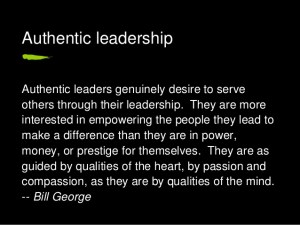
But Authentic Leadership is something different. Being an Authentic Leader requires more than mere influence. It requires that you use that influence in a way that positively impacts the lives of the people you lead.

Authentic Leadership begins when you care for the people you lead. That’s because Authentic Leadership requires that the leader put their people first. If you don’t care for the people you lead it’s nearly impossible to put them first.

When you care for your people and you put them first it leads to enthusiastically helping your people succeed. It leads to making a positive difference in their lives.

That’s why the one absolute measure of whether a person is an Authentic Leader is whether or not they have helped make the people they lead better. Better at what they do, better at how they do it and better at why they do it.

Authentic Leaders make a difference in their people’s lives. They do it with no expectation of receiving anything in return for themselves. It may indeed help their organization but that’s not their primary motive for helping their people. They help their people in almost anyway they can because it’s the right thing to do.

A leader can have a large dose of success in many areas but if they haven’t helped another person reach their potential and achieve more than that person thought possible then they may be a Leader but I would not define them as an Authentic Leader.

If you’re wondering whether or not you’re an Authentic Leader you don’t need to wonder anymore. Look around at the people you’ve been leading. Are they better off because of the positive impact you have had on their life? Would they agree that you’ve had that positive impact if they were asked.

If the answer to both those questions is not a solid yes then you have some growing to do as a leader. That growth begins with a decision that says “I will LeadToday.” When you make that decision to authentically lead you won’t only change the lives of the people you lead, you’ll likely change your life as well.